Use it for sustained loads
Glass fibre raises creep strength and dimensional stability, so parts hold their shape under long-term load and heat.
Adding 30% glass fibre to nylon 6 makes it much stiffer and stronger, and improves its creep strength and dimensional stability. It suits parts that carry high loads for long periods, including at elevated temperature. The trade-off is toughness, and the fibres are abrasive.
 GF30Plastics
Figures from one named manufacturer or industry data sheet, compared with our other CNC plastics. See every material side by side in the property comparison.
Data source: Ensinger TECAMID 6 GF30 black (stock shapes). Typical values, not guaranteed minimums.
Guide only. General ratings for prototyping, not a recommendation for your application. Filter every material by these needs.
Every material has trade-offs. Knowing them up front saves time and money.
Practical points to consider when you design a part in Glass-filled nylon.
Glass fibre raises creep strength and dimensional stability, so parts hold their shape under long-term load and heat.
Glass fibres are abrasive to mating parts, so the manufacturer rates it less suitable for sliding applications.
With only 5% elongation at break, snap fits and thin flexing features are better made in unfilled nylon or acetal.
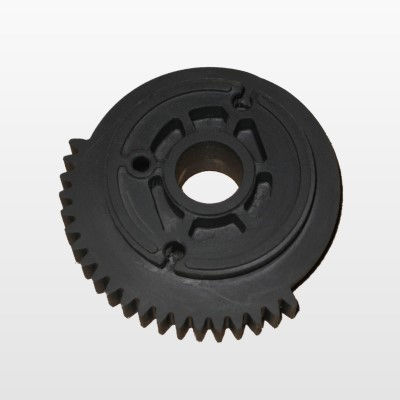
Structural brackets, housings and mechanical parts under sustained load, in mechanical engineering, electronics and automotive applications.
Compare them all in our material overview or narrow them down with the material selector.
Common questions about Glass-filled nylon. Still unsure? Contact us or call +61 3 9764 2749.
About 70% stiffer than unfilled nylon 6: 5.7 GPa against 3.3 GPa.
It is much less ductile than plain nylon (5% elongation at break), so it is less forgiving of impact and flexing.
Our figures are for a black stock grade, Ensinger TECAMID 6 GF30 black.
Please use this information as a guide only. It is a general rapid prototyping reference based on typical results, and many assumptions were made in producing it. It is not a recommendation for any particular application, so please don't use it for product design or engineering decisions. The final choice of process and material is yours; check critical properties with the material manufacturer's data sheets.
Upload your CAD files for a free, obligation-free quote.